Ice Is(n’t) Nice - A Rushed Guide to Ice Colony Classic/V1.
Hello, all! As I’m sure the majority of you are aware, it is December and as we all know, December means it is Ice Colony Classic time!
As I am as generous as I am artistically gifted, I’d like to give you all an early Christmas Present: The hopefully correctly annotated map of Ice Colony Classic/V1, created from memory by a very exhausted mentor. This guide also includes a rudimentary strategic theory guide for the USCM* on how to proceeded with any offensive actions, from a CIC neverplayer!
*Authors note: The ‘theory’ aspect of this guide is hidden in a collapsible section below the map guide. You can click it to collapse the section and view the theory guide. It has been labelled as ‘Click me’.
The Actual Guide!
Ice Colony Classic V1: A Quick Re-Orientation With The Map
Image Key:
Grey+Red+Blue Arrows: Ladders connecting the upper and lower parts of the colony.
Green arrow: Ladder connecting to the crashed Yautja ships to the upper part of the colony.
Black Arrows: Above-ground and below-ground elevator connections.
Green Outline: Alamo Landing Zone, LZ-1 (Presumed).
Red box: Normandy Landing Zone, LZ-2 (Presumed).
Yellow box: Power generator + distribution (SMES).
White box: Comms Suite.
Elevator pictograms: Elevator locations.
Important note: It does not appear that the map in its current revision on the final day of writing (6/12/2025) has a sensors relay.
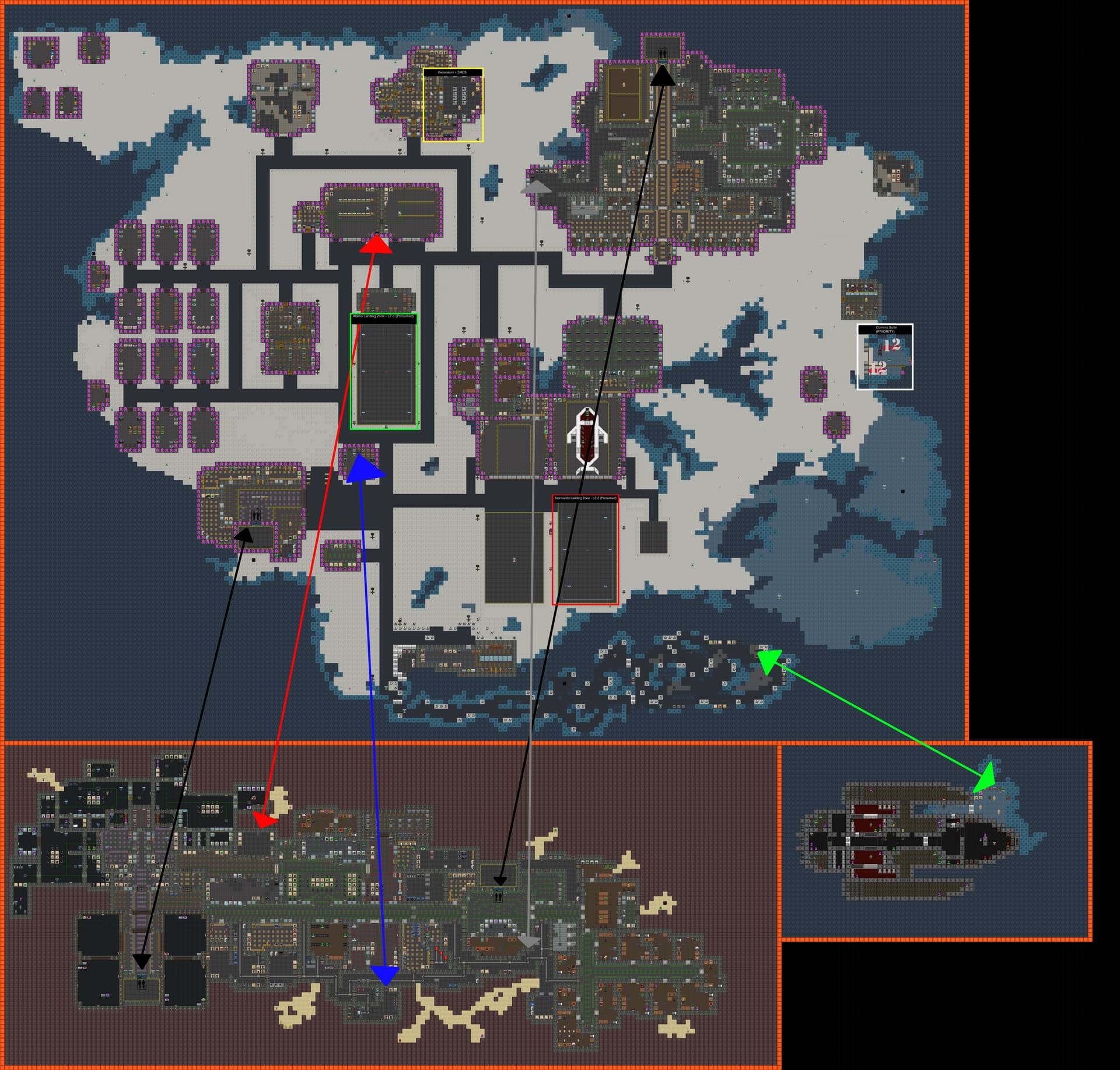

(For a non-edited version, please consult this page: https://cm-ss13.com/w/images/8/88/Ice_V1.png)
Basic Theory For Battle, Ice Colony Classic V1 - Click me!
Basic Theory For Battle - Ice Colony Classic.
Foreword: A Unique Colony.
Ice Colony Classic/V1 is unique in the fact that it is split into two parts: The above-ground section, and the below-ground section, which can be traversed in two primary ways: The ladders are ideal for small group-troop movement, and the elevators suited for large troop movements.
This makes any offensive actions rather slow, tedious and almost always requires you you to commit any actions, as retreating is not as easy as running south towards the FOB.
Additionally, the communications units are bundled together; in short, this means that holding both is more practical, which in theory allows for easier deployment of a nuclear weapon, should the round be a two-hour long standstill.
Part One: Guarantees for A (Relatively) Safe Operation.
The easiest way to get a large fighting force from the above-ground portion of the map to the below-ground portion of the map is to use the elevators, though this is a double edged sword, as once you’re below, the elevator has a cool-down period of a few seconds seconds, and the below-ground elevator area is usually well defended.
You’ll want to guarantee a few things before you order the descent:
- Ensure the FOB is well made and well defended.
- Ensure the FOB is well-stocked, including with building material supplies for the Combat Technicians, as they have to surround pretty much the entirety of the landing zone
- Ensure that both communications relays are secure. they are in the same location (Mid-east side of the map, marked with a white square.) A viable, albeit boring strategy for the marines is to hold the communications relays and wait for the nuke.
- Ensure that SMES units (Mid-north of the map, marked with a yellow square) are charging and distributing power.
- Ensure that the back-line is relatively secure.
- Ensure that the majority of known above-ground tunnels are collapsed, so you can’t easily get flanked while making the dark descent.
- You may also wish to make lightly manned and lightly defended outposts at the above-ground ladders to prevent any xenomorph advances or scouting attempts.
Part Two: The Dark Descent.
Assuming that a 1/4th (Bravo Squad) of the marine forces are split between the Forward Operating Base and the Combat Outpost at communications, you should have 3/4ths (Alpha, Charlie and Delta) of the remaining force ready to fight. While the obvious instinct is to rush the elevator once everything is in order, you’ll usually want to reinforce the above-ground portion of the elevator, to ensure that your wounded and retreating forces don’t get a greeting party comprised of Lovecraft’s’ greatest horrors.
It is likely that the below-ground portion of the map will be heavily fortified, slowing any attempted advances to a crawl; the obvious counter to this is the M6H BRUTE, though availability of the weapon and its munitions (The M6H BRUTE rockets) is dependent on the personal preference of each individual combat technician; Coordination with offensively-armed combat technicians is all but essential. You may also wish to get requisitions to send some rockets down, though any M6H rocket orders will quickly eat through the budget, so it may wise to ask any personnel carrying the M6H BRUTE to use their rockets sparingly.
The below-ground front-line is easily rout-able*, for this reason, you may wish to order squad-level medical personnel to stay within the elevator and to set up a triage point within, or near the elevator until the Marines have a strong enough foothold.
*Authors note: a ‘Rout’ is defined as ‘a disorderly retreat of defeated troops.’, this is especially a concern on Ice Colony Classic as the below-ground colony is comprised of tight and long hallways, accompanied by even more cramped maintenance tunnels, an example of why this is an issue is if Xenomorphs commit a Hammer and Anvil-style flanking maneuver, it may cause either a rout, or a wipe. For this reason, it is vital that communication between ground forces and command is maintained, to be aware of any possible flanking attacks/maneuvers, ideally before they happen.
If the amount of casualties is too large, or opposition too fierce, it may be worthwhile to call a retreat. If this comes to pass, you should ideally attempt to recover and revive any casualties, as leaving anyone in the lower-levels will surely result in their permanent deaths.
Once a retreat has been executed, you may not have enough troops to take any offensive actions. Attempt to consolidate somewhere, such as the communications relays, a forward combat outpost, or the forward operating base. If you do not have enough troops to fight, it may be worthwhile to consider evacuating to the USS Almayer.
Part Three: Good Luck!
The exact details of the plan are up to you. You could have a small diversion force head down one ladder or elevator, while a larger flanking force takes another, or you could throw caution to the wind and do the strategic equivalent of betting all your chips on black, and order an all-or-nothing attack by an elevator.
In any case…
Good luck, Commander. You will need it.
Closing Remarks.
I’m pretty sure this is the first guide I’ve managed to release (And within days of first writing it, no less!). Any feedback, suggestions or corrections are, as always, greatly appreciated!
More guides will hopefully follow!
Quick note: Despite the name of the guide, I rather enjoy Ice Colony Classic. Its almost reminiscent of the gameplay loop of Aliens: Dark Descent… Almost!
Until I write again, remember to have a Colonial Marines year!