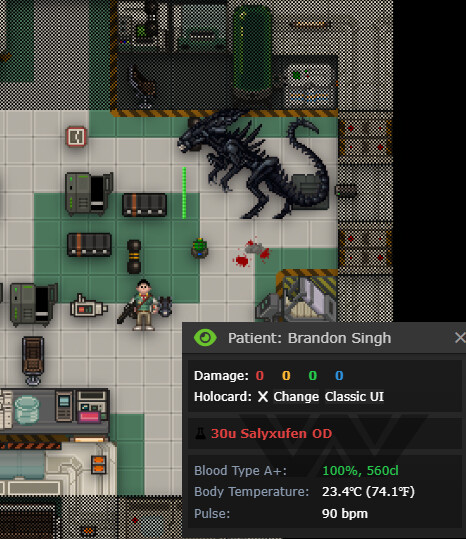
Reposting an old guide I wrote for research players on how to do a strategy I’m very fond of. Has since been nerfed pretty heavily in effectiveness, and changed a little. Hope new researchers attempt it and get creative with more strategies like it. Enjoy.
Tesla Gas!
I call it NERV gas.
Preamble
What it does, why it does, and why you should do it too.
The goal of Tesla gas is to be a marine-safe(r), mass-producable debuff and weed-clearing tool that facilitates pushes and helps maintain momentum. It does this by disabling Xenomorphs ability to heal, communicate, and more-or-less, to use abilities. On higher NEU levels, it can repel key xenomorphs (Praetorians, Hivelords, Drones, Ravagers, Queens) by draining their plasma - but this isn’t enough for it to run defensive or hold FOB by itself - especially compared to even basic flames. Because of all of this, Tesla gas is only useful when marines have the momentum, or during a stalemate situation, but combined with proper gear and marines who are aware of how the gas works, it can cement a push into an easy victory, especially if used well against a Queen.
Theory
How it all works.
The ideal recipe for Tesla gas looks something like this:
HMR3+/(NEU3+)/DSR1/NRT2/(REP4+)/TXC1/CMB2
Bracketed properties, REP/NEU are optional.
Repairing (REP) helps offset the gas’ inherent weaknesses by repairing barricades (and synthetics) on contact, but it can be hard to use around marines. Every level of repairing raises the health restored by full gas exposure by 30 points. For example, REP5 restores 150/450 of an unreinforced metal barricade’s health. This property can only be acquired through synthesis papers and contracts.
Neutralising (NEU), on the other hand, massively helps the gas’ offensive capabilities by draining their plasma - preventing xenomorphs from retaining a power budget on repeated flanks/pushes. NEU3 and higher can consistently put xenos into the red, with NEU5 depleting a drone caste completely after ~3 seconds of exposure. This forces a lot of castes to retreat early, or fumble without access to key abilities for retreating and pushing.
Cryometabolizing (CMB) is the only property on this list that isn’t optional, as it prevents marines from suffering metabolization effects of the incredibly negative properties in this list. Any level above 1 is unnecessary, the property is included for its ability to prevent metabolization outside cryotubes, increasing its effectiveness inside cryotubes doesn’t benefit.
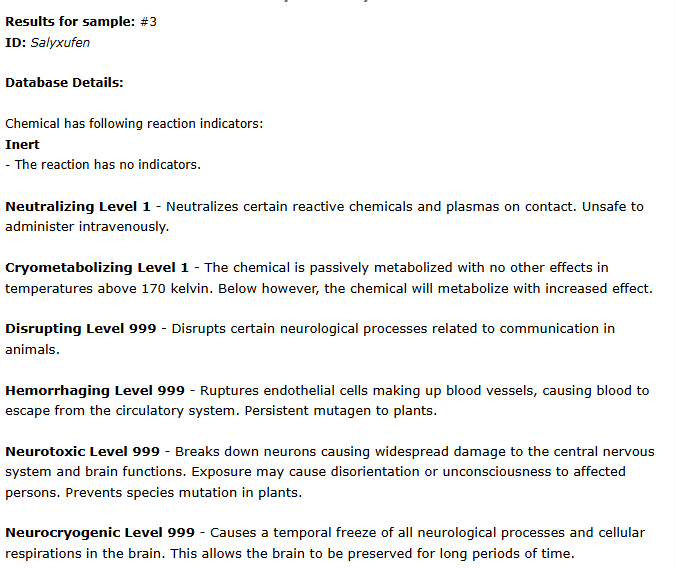
Disrupting (DSR) interrupts the Xenomorph hivemind. This prevents affected xenomorphs from communicating over radio, accessing overwatch (“Watch Xeno” verb), and prevents affected xenomorphs from being watched. If the queen is affected by this, for a period after disruption, she cannot provide remote healing, but can still change the tac-map, mark resin, and make announcements. This, like a variety of other properties in this list, lasts up to 50 seconds, with increasing debuff “stack” buildup on contact. DSR1-2 is best for this property, but higher levels scale in effectiveness against hive leaders and Queen xenomorphs.
Hemorrhaging (HMR) prevents xenomorphs from healing after contact. This prevents resting on weeds, pheromone healing, overwatch heal, gardener heal, and direct healing abilities. Affected xenomorphs gain a red outline. The power of this ability is fairly self-explanatory. The advantage xenomorphs have over marines are their ability to hold momentum without expending resources. Healing is a massive component of this, even individually a xenomorph is a lot weaker when they have to wait an extra 10-50 seconds to start healing again. This is balanced by a grace period of 30 seconds after suffering the effects of HMR - this means it’s a viable property to amp, with 3 being a good starting off point. Marines will suffer the effects of this temporarily on exposure even with CMB.
Neurotoxic (NRT) gives Xenomorphs weldervision (1.5 tile view reduction) and prevents autofire abilities. How this affects an individual caste varies. For example, runners lose access to far-sight and Queen to Scream. It is also the only visually indicated property outside of HMR. NRT2 is where the property best balances cost and effectiveness, lasting about 10-20 seconds even on minor exposure. Marines will suffer the effects of this temporarily on exposure even with CMB.
Toxic (TXC) removes weeds on contact, helping marines push. It is best to keep this property as low as possible, given its touch effect causes toxin buildup. Marines will suffer the effects of this temporarily on exposure even with CMB. Given proper dylovene dosage, this can be almost entirely avoided.Two properties that aren’t mentioned are Neurocryogenic (NRC) and Corrosive (CRS).
Neurocryogenic slows xenomorphs on contact. This is, for obvious reasons, really useful. Unlike the other properties, however, NRC’s touch effect deals stamina damage. This cannot be avoided through the CMB property, and is ultimately far more damaging to marines and their ability to push than any other property on this list.
Corrosive, on the other hand, reduces Xenomorphs armor-point total temporarily, increasing the effectiveness of normal ammo - it will, however, also melt helmets on contact. It’s often not worth the consequences to the marine command structure, as well as to FTLs’ nightvision and medhuds. You will more than likely just annoy marines into writing off the gas as too risky.
For the most part, NRC and CRS should be avoided. If you want to use CRS, it has to be level 8+ to have any effect on xenos, copy from chlorine trifluoride. If you want to use NRC, no higher than level 2-3.
One thing of note is that CMB cannot prevent touch effects of gasses, but surprisingly- wearing any gas mask available prevents touch effects as well. A marine wearing a gas mask is capable of travelling entirely through gas without any harm.
Among other things, this means the OD threshold of the paper is largely ancillary - which is a point most important in the creation methodology.
Don’t use these gas effects in HvH or you will get bwoinked
Methodology
Or, you know, how you can make your own.
Before you do anything; call up the CIC, Requisitions and OT and tell them what you’re going to be doing, and what you need from them. Marines don’t know what Tesla gas is, what it does, or why they should use it - use the CIC to tell them what they should know. Requisitions doesn’t know what to do with anything that isn’t an autoinjector, tell them where they should send it, and to send labelled gas masks with it. The Ordnance Technicians are capable of producing the tanks used to store the gas, so you’ll likely want them on board, first. Informing the pipeline is the best way to have it operational, and not doing so will likely have every tank left in FOB unused.
When it comes to synthesis simulation, Tesla gas is too expensive to produce from scratch without relating. This is a best recommended strategy to build off a strong base with negative properties (something with high NEU/HMR/REP especially). Ideally, you’ll want as many level 1 properties as possible, and you’ll want to relate as much as possible. A lot of these properties are only available at level 1. Without relating, the cost of the average production sits somewhere above 20 points, with a lot of ADDing, and thus a lot of negative properties left completely inaccessible. Using relating, that cost can reduce dramatically, especially with a good base.
Every property excepting REP can be acquired through these dispenser-friendly chemicals;
Cryoxadone - CMB2
Fluorine - NEU1
Radium - HMR1
Mercury - DSR1
Impedrezene/Mercury - NRT2/NRT4
Generic Toxin (Paracetamol) - TXC1
These should be scanned as soon as you have them available.
Generic Toxin is Nitrogen/Water/Tramadol 1:1:1. Produces 60 Paracetamol and 60 Toxin. Scan the toxin for TXC1.
Impedrezene is Mercury/Oxygen/Sugar 1:1:1.
In most circumstances it’s best to make a starting paper the base for this chemical, and to use contracts with NEU/HMR/REP as desired targets. A lot of papers will include HMR/NEU/DSR/NRT as common properties, and HMR/NRT/DSR count as negatives - which reduce the cost amplification and suppression in papers, and their total value. This can mean it’s often cheaper to relate and amplify, than add a property at a higher level. It’s often best to start building this chemical once you have a few NEU/HMR/REP contracts done, as it’ll let you consider better and cheaper bases.
When the final simulation is done, your chemical should be stored inside a reagent tank. You’ll want to produce Custom Upgraded M240 Incinerator Smoke tanks inside the Biomass Analyzer, or produce regular Custom Smokes inside the OT’s Armylathe (call them up beforehand). Setting this up in the turing is best, as this strategy is best paired with a followup project that you won’t have time for if you’re actively labouring on the gas.
Once the tank has above 100-150u, you can fill a smoke tank with the reagent tank to fill it. You should, ideally label the tanks a variation on NERVE GAS - MARINE SAFE GAS - TESLA GAS. As an exhaustive explanation of properties is impossible, Tesla remains the best immediate descriptor for what the gas does, as it shares a lot of the effects on xenomorphs. Anti screech or anti queen also gets the idea across.
For ease-of-access, send filled custom tanks through the requisitions latch above the biomass analyzer, at which point, the work is done.